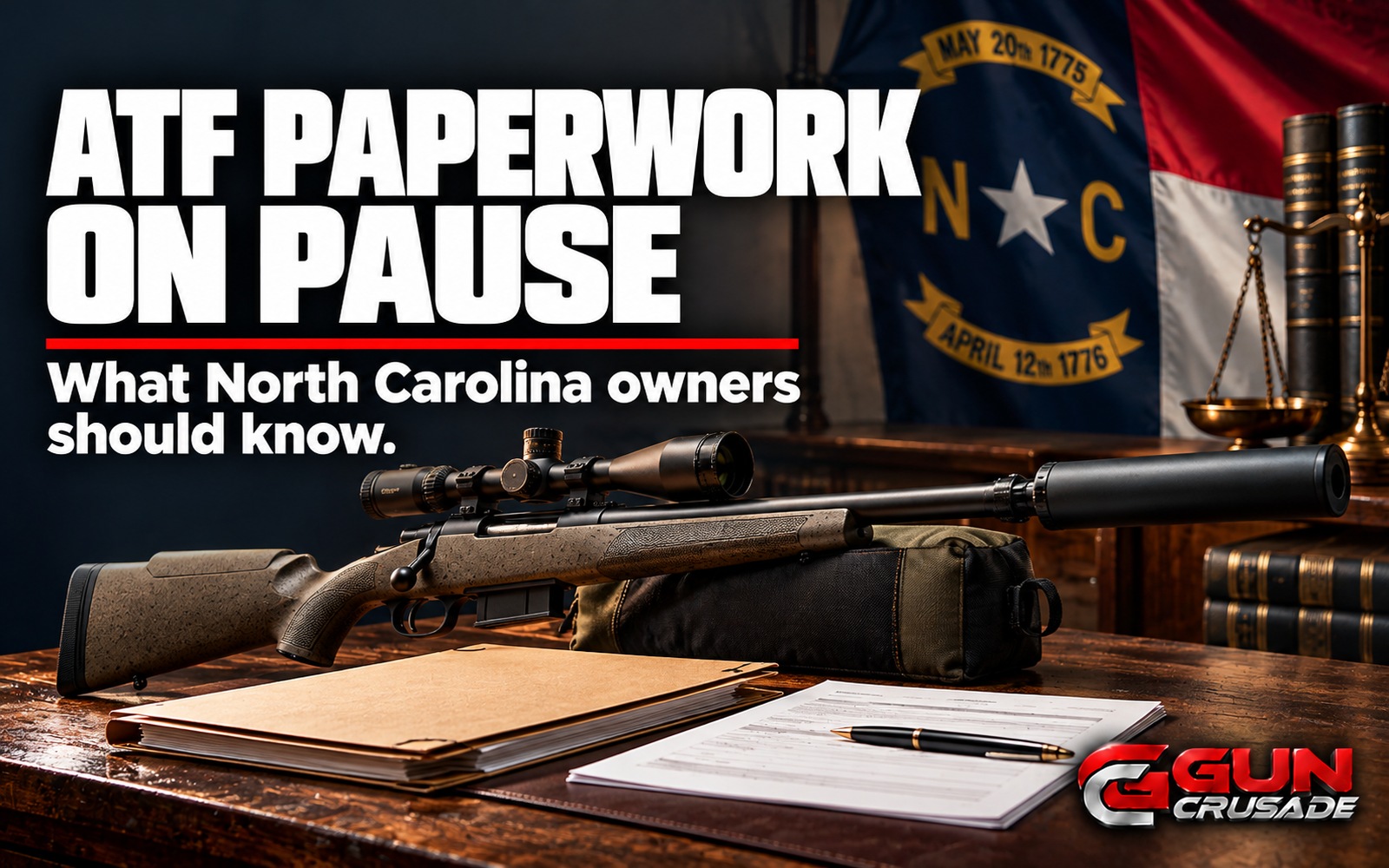
The federal government has stopped enforcing most National Firearms Act paperwork for four categories of firearms: suppressors, short-barreled rifles (SBRs), short-barreled shotguns (SBSs) and the catch-all class known as “any other weapons” (AOWs). As first reported by Guns.com’s Chris Eger, the change took effect Friday, October 9, 2026.
Jurisdiction and status: Federal (nationwide). This is an enforcement policy now in effect, not a repeal. The NFA itself remains on the books.
How we got here
Congress reduced the NFA making and transfer tax on these items to $0 in last year’s budget legislation. On August 5, 2026, a federal court in the Northern District of Texas ruled in Silencer Shop Foundation v. ATF that, with the tax at zero, the NFA’s making, registration and transfer provisions could no longer stand for those items. The court’s injunction covers only the plaintiffs, their members and others named in the order.
Guns.com reports that Attorney General Todd Blanche chose not to appeal, and the Justice Department applied the result to everyone. ATF’s own guidance, which we reviewed, confirms it will not enforce prior approval to make or transfer these items, registration in the national registry, or the NFA marking rule, for all persons. ATF Director Rob Cekada said, “The direction from the President, Congress, and the courts is clear.”
What still applies
- Background checks: Buying from a dealer still means a Form 4473 and a NICS check, with dealer record-keeping.
- Machine guns and destructive devices: Still fully under the NFA, including the $200 tax.
- Crossing state lines: ATF says individuals must still file Form 20 before taking an SBR or SBS to another state.
- Prohibited persons: All the usual federal rules remain.
- State and local law: Federal policy does not override state bans or requirements.
ATF will still accept NFA registrations voluntarily. Its guidance warns there is no automatic grandfathering: if the injunction is overturned, Congress imposes a new tax, or the guidance is rescinded, unregistered items could again be treated as contraband, and any amnesty would be at the Attorney General’s discretion.
The North Carolina question
Guns.com lists North Carolina among 15 states whose laws tie the legality of some NFA items to federal rules. The others named are Alaska, Colorado, Connecticut, Georgia, Michigan, Mississippi, Montana, Nevada, North Dakota, Ohio, Oregon, Pennsylvania, Washington and Wisconsin.
North Carolina’s statute, G.S. 14-288.8, defines short-barreled rifles and shotguns and silencers as “weapons of mass death and destruction.” It exempts people who possess them “in compliance with” the federal NFA, 26 U.S.C. Chapter 53. Whether owning an unregistered item counts as “compliance” while federal enforcement is paused has not, to our knowledge, been answered by North Carolina courts, lawmakers or the state Attorney General. Neighboring Georgia is also on the list.
For comparison, Mississippi’s Attorney General issued a statement on October 12 saying a Form 4 is no longer mandatory for suppressor transfers under that state’s law, while still allowing voluntary filing, according to NRA-ILA. No similar North Carolina guidance had been issued when we checked.
GUN Crusade’s take: what to do now
This is a significant shift, but it rests on a court order and an administration’s choice, both of which can change. If you live in North Carolina or another state on that list, the cautious path is to keep filing NFA paperwork until state officials or lawmakers clarify things. If you already have items registered, keep your approved forms safe. Ask your dealer how it is handling transfers, since dealers may set their own policies. And if you travel with an SBR or SBS, don’t skip the Form 20.
This is news, not legal advice. Laws change, and your situation may differ; check with a qualified attorney or your state and local authorities before acting.