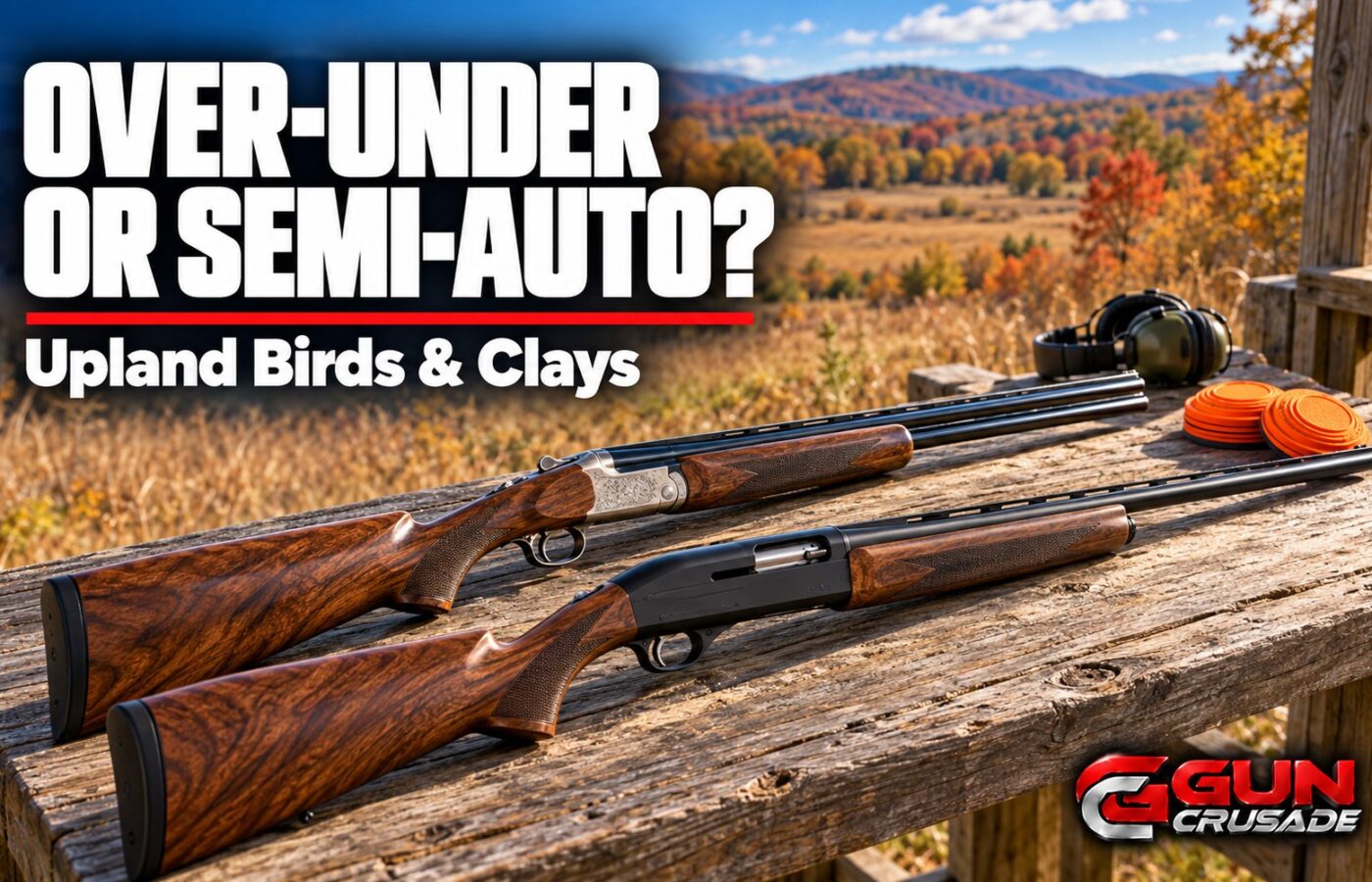
Spend a morning behind a bird dog or a day on a sporting clays course and you will see both: shooters carrying graceful over-unders and others carrying semi-automatics. Neither is wrong. Here is how to choose.
The over-under
Two barrels, two shots. An over-under fires one barrel, then the other. Many let you choose which barrel fires first, and you can run two different chokes, like improved cylinder for the first shot and modified for the second.
Strengths:
- Visible safety. An open over-under is obviously unloaded. That’s why it’s the preferred gun on many clays ranges and hunts.
- Simplicity and reliability. It will fire any shell that fits, regardless of power.
- Balance and handling. A good over-under points naturally.
Weaknesses: Only two shots. More expensive, though budget models like the EAA Balikli Blue Label ($479) from American Rifleman’s 2026 list have lowered the price of entry. Often heavier than a comparable semi-auto, which some shooters see as an advantage for recoil.
The semi-auto
Strengths:
- Softer recoil. The action absorbs some recoil, especially with gas-operated guns.
- Three shots. Useful for flushes of quail or doves where legal.
- Value. A quality semi-auto often costs less than a quality over-under.
Weaknesses: Needs more cleaning, especially gas guns. Some are sensitive to light loads. Spent hulls fly out of the gun, which annoys some shooting partners and makes some ranges ask you to pick them up.
For the upland hunter
Weight and handling matter most when you carry a gun all day. A light 20-gauge over-under or a trim semi-auto like Benelli’s Montefeltro Silver Featherweight (from American Rifleman’s 2026 list) both work well.
For the clays shooter
Serious clays shooters lean toward over-unders for their handling and visible safety. High-volume shooters who are sensitive to recoil often prefer gas semi-autos.
Safety in the field
Whatever you shoot, upland hunting with others requires discipline:
- Keep your muzzle pointed safely, especially when birds flush low or a dog is near.
- Know your safe zone of fire and never swing through your partners.
- Wear blaze orange where required and where it makes sense.
- Open the action when crossing fences, climbing banks or taking a break.