While most North Carolina hunters have deer on the brain this time of year, one of the state’s oldest coastal traditions is quietly playing out in the salt marshes. In a Field & Stream feature, longtime contributor T. Edward Nickens describes how rail hunting on the Cape Fear River estuary offers fast shotgunning, a unique boat-based hunt and a direct link to sporting history, along North Carolina’s southeastern coast.
Under the North Carolina Wildlife Resources Commission’s 2026-27 migratory game bird proclamation, the rail season runs September 5 through November 25, which leaves about a month for anyone who wants to try it this year. Today, October 25, is a Sunday: the season’s date range does not authorize migratory-bird hunting today.
What Rail Hunting Looks Like
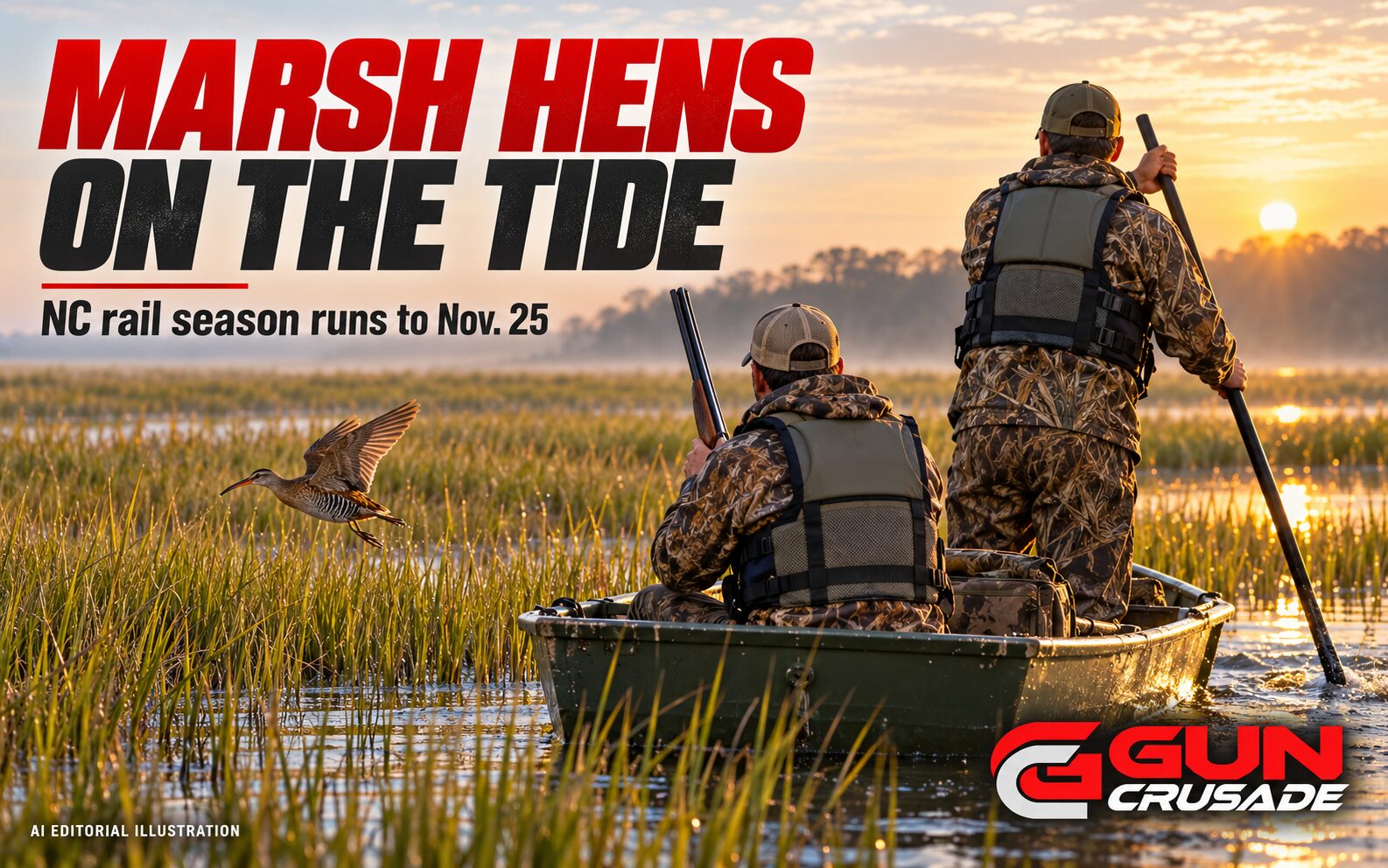
Rails, often called marsh hens or mud hens along the coast, are secretive birds that live in tidal marsh grass. Clapper rails are the most common species in the Cape Fear marshes, according to Field & Stream, with king rails, Virginia rails and soras (sometimes called Carolina rails) also present.
The classic method is a two-person team in a shallow-draft johnboat or skiff: a gunner stands in the bow while a “pusher” in the stern poles the boat through flooded marsh grass. When a bird flushes, it usually does so close and flies a short, slow hop of 50 to 60 yards before dropping back into cover. Nickens describes waiting until birds were roughly 20 yards out before shooting, and passing on birds sitting on the water.
The sport has deep roots. Field & Stream notes that rail shooting was popular with sportsmen in the 1800s and early 1900s, and that both Benjamin Harrison and Theodore Roosevelt hunted rails.
Timing Is Everything: Tides and Weather
Rails are hunted on the highest tides, when water floods the marsh and pushes birds into the taller stands of grass where a boat can reach them. Those big tides typically come around the full and new moons. As the tide falls, the birds get much harder to flush, so the window on a given day can be short.
The guide in the Field & Stream story pointed to a full moon following a storm up north as the best setup, since weather can push migrating birds south. Moon phases alone do not establish the time or height of a huntable local tide. Use NOAA’s North Carolina tide predictions for the nearest relevant station, then account for wind, weather, travel time and local access.
North Carolina Rules to Know
Here is what the NCWRC’s 2026-27 proclamation sets for rails:
- Season: Sept. 5 to Nov. 25, 2026.
- King and clapper rails: 15 per day combined.
- Sora and Virginia rails: 25 per day combined.
- Possession: three times the daily bag.
- Shooting hours: one-half hour before sunrise until sunset.
- No Sunday hunting: The proclamation states there is no hunting of migratory game birds by any method on Sundays in North Carolina, and rails are migratory game birds.
Federal migratory bird rules also apply. Under 50 CFR 20.21, it is illegal to shoot from a boat with a motor attached unless the motor has been completely shut off and the boat’s progress from it has stopped. That is why rail hunters cut the motor and switch to a push pole once they reach the marsh. The three-shell rule applies to rail hunting: capacity is counted across the chamber and magazine, and any required one-piece plug must not be removable without disassembling the gun. Federal rules also prohibit using a motorized craft to concentrate, drive, rally or stir up migratory birds; switching the motor off only at the instant of shooting does not cure that separate violation.
All licensed rail hunters in North Carolina need HIP certification; NCWRC lists an exception for people legally exempt from the hunting-license requirement. Confirm the hunting privileges and any area permits you need. Rails are webless migratory birds, so do not assume every waterfowl-specific rule applies identically. NCWRC’s general nontoxic-shot requirement covers waterfowl and coots; posted game-land waterfowl impoundments and federal refuges can impose additional site rules. Check the exact property’s current regulations before choosing ammunition.
Gear and Getting Started
You don’t need a magnum gun. Nickens shot a 20-gauge over/under, and close, slow flushes reward a light, quick-handling shotgun with an open choke. A suitable shallow-draft boat, a push pole, a properly fitted life jacket worn by each person, weather protection and a dry bag for licenses and phones round out the list. Keep the boat stable and the muzzle clear of your partner; do not stand unless the boat and conditions safely permit it.
If you’ve never poled a boat through a marsh on a spring tide, consider hunting with an experienced friend or a licensed guide the first time. Tide timing, mud and oyster beds can catch newcomers off guard.
As for the table, rails have a reputation for tasting poor, but Field & Stream reports good results grilling them simply or searing marinated breasts. Like any wild game, careful field care makes the difference.
For North Carolina bird hunters looking for something new before deer season wraps up, a fall morning in the marsh on a big tide is hard to beat. This is news, not legal advice. Always check current NCWRC regulations before you hunt.
Cover image: AI-generated editorial illustration, not manufacturer product photography or a documentary photograph of the reported hunt.