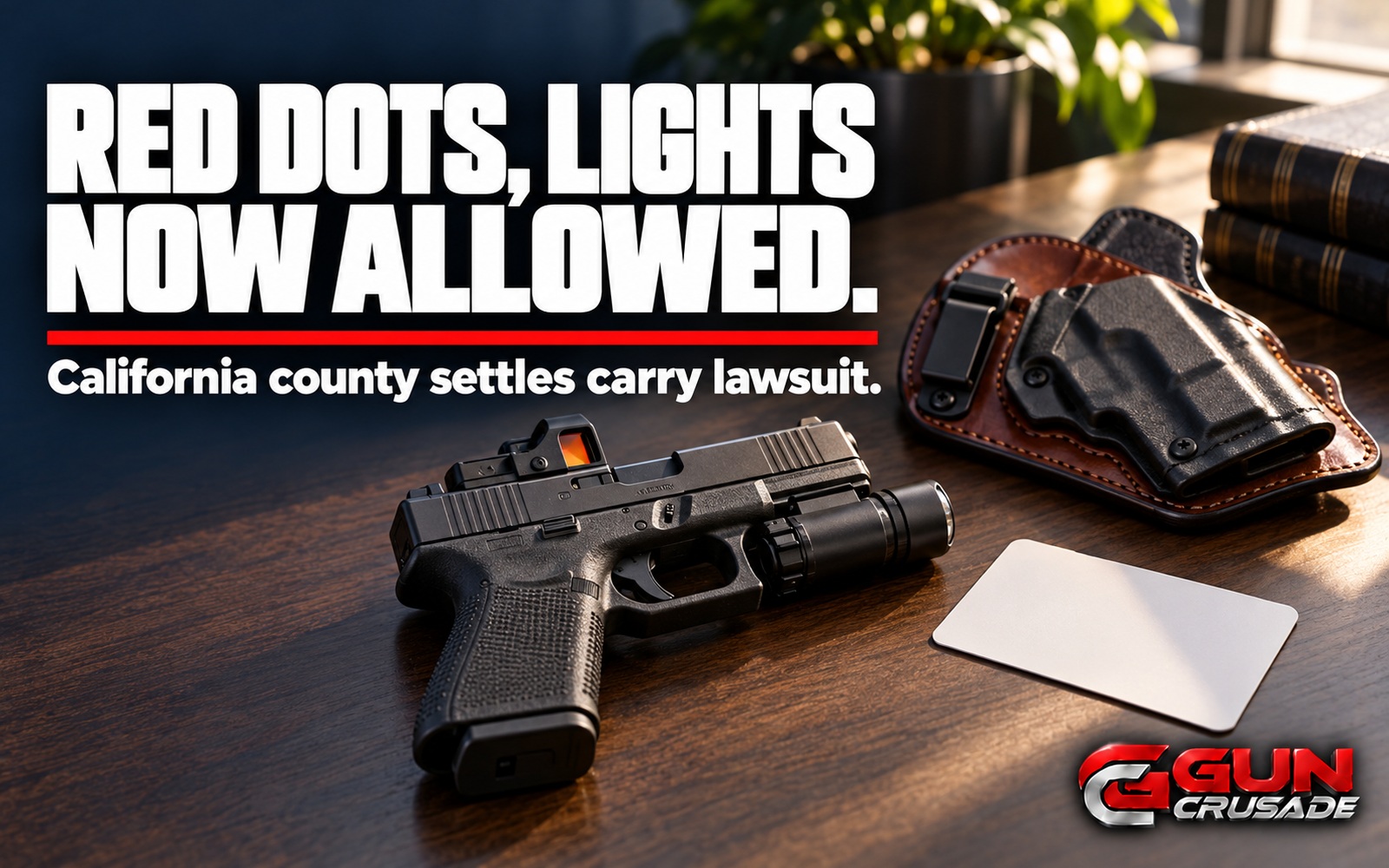
Concealed carry permit holders in Contra Costa County, California, will no longer be barred from carrying handguns with red-dot sights or weapon-mounted lights, or from carrying single-action 1911- and 2011-style pistols. The change comes from a settlement between the county sheriff’s office and the Second Amendment Foundation (SAF), as first reported by The Firearm Blog on October 20, 2026.
The story is from California, but it touches on something carriers everywhere care about: whether the gear that helps you shoot well and see clearly can be carried legally.
What the Old Rules Said
In Contra Costa County, a concealed carry license lists the specific handguns the holder may carry. The sheriff’s posted permit rules went further, rejecting handguns fitted with red-dot sights or lights and barring single-action-only pistols, with the 1911 named specifically.
SAF and two county residents, Andrew Moore and James Treuel, sued in June, arguing that the conditions violated the Second and Fourteenth Amendments. The dispute was about which handguns a licensee could carry, not whether residents could own those guns or accessories.
What the Settlement Changes
SAF announced the settlement on October 8, and the plaintiffs filed a notice of voluntary dismissal the next day. According to SAF, the sheriff’s office agreed to:
- Withdraw its prohibitions on red-dot sights, weapon-mounted lights, and semiautomatic single-action 1911 and 2011 pistols carried under a county license.
- Update its concealed carry website within 10 days.
Some things did not change. Applicants must still pass range qualification with every handgun they list. SAF says an existing licensee who adds an optic or light to a listed pistol may need to bring it in for inspection and requalify with the accessory installed. Listed guns must still comply with California law.
SAF’s Kostas Moros said a sheriff “does not get to invent a shorter list” of approved handguns and accessories than the Constitution allows.
Status: Settled, Not Ruled On
A few details matter here, and The Firearm Blog was careful to point them out:
- Jurisdiction: Only Contra Costa County sheriff’s permits are covered. Other California licensing agencies are not affected.
- Status: The case was settled and voluntarily dismissed. No court ruled that the old policy was unconstitutional, so the outcome does not set a legal precedent.
- Other rules remain: The announcement does not say the county lifted its limits on laser sights, certain firearm modifications, or the number of handguns a permit may list.
- Paperwork lag: The Firearm Blog reported that as of October 15, the sheriff’s online permit instructions still showed the old prohibitions.
Because of that lag, permit holders should confirm with the sheriff’s office before changing the setup of a listed handgun. The sheriff’s CCW permit page and SAF’s settlement announcement are the primary sources to watch.
Why It Matters Beyond California
Red-dot sights and weapon lights have gone from specialty items to standard equipment on many carry pistols. A dot can help shooters, especially those whose eyes are not what they used to be, keep their focus on the threat. A light helps you identify what you are looking at before you ever decide to shoot, which is one of the most basic rules of responsible gun ownership.
The 1911, meanwhile, has been carried by Americans for more than a century. Restricting it by action type struck many carriers as arbitrary.
For readers here in North Carolina and across the Southeast, the takeaway is practical: know exactly what your own permit or carry law says. Most of us will never face a rule like Contra Costa’s, but carry laws, permit conditions and local policies differ, and they change. A few good habits apply wherever you live:
- Read your permit and your state’s carry statute. Know whether your permit is tied to specific guns or simply to you.
- Qualify with what you carry. Even where the law does not require it, train with the exact gun, optic and light you plan to carry.
- Check before you travel. Reciprocity and permit conditions can differ from state to state and even county to county.
This article is news, not legal advice. For questions about your own situation, contact your permit-issuing agency or a qualified firearms attorney in your state.