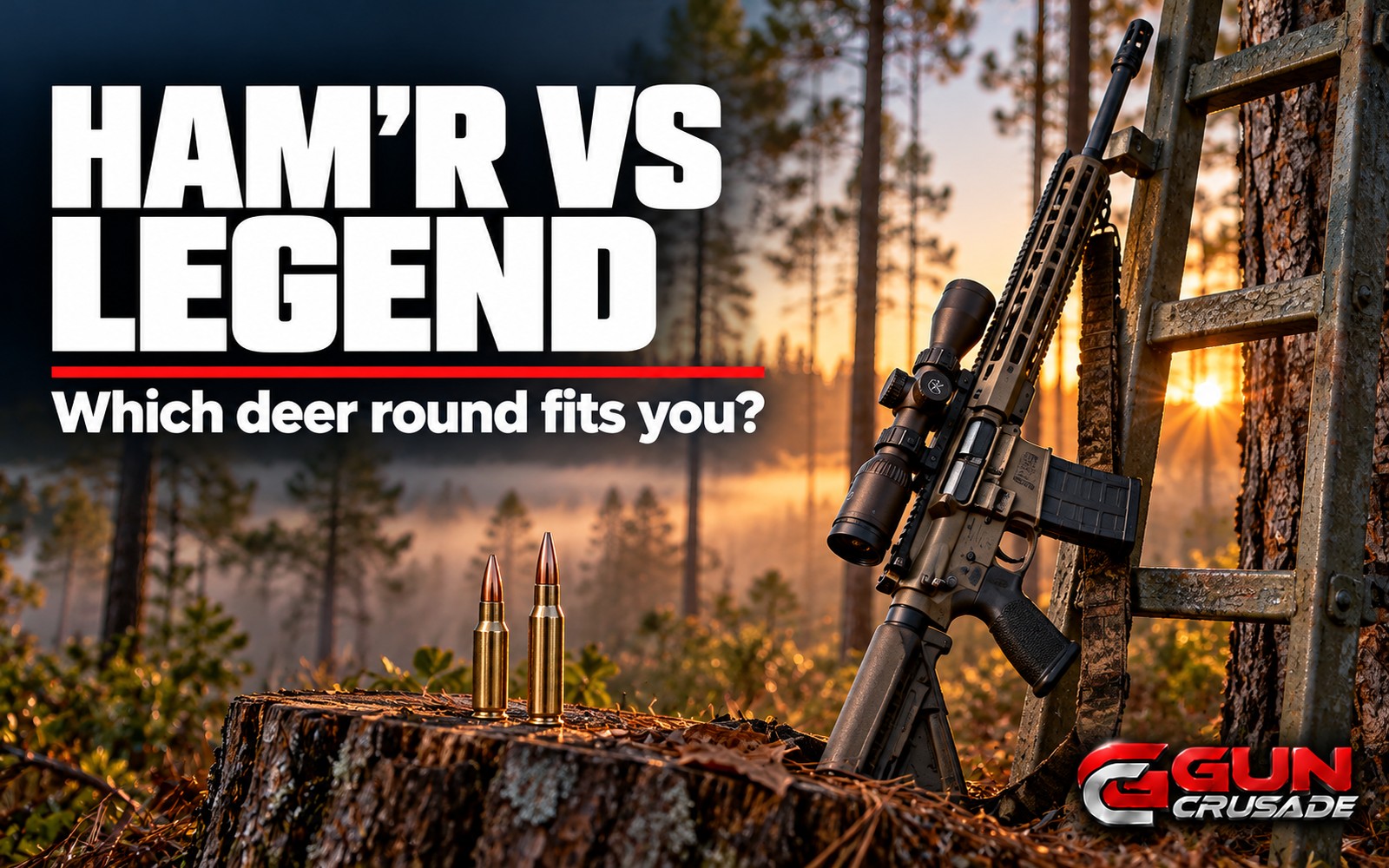
Walk into a gun counter in deer season and you will hear plenty of talk about cartridges that make a short, light rifle into a real deer-and-hog gun. Two of the most interesting are the .300 Ham’r and the .350 Legend. They came out of the same push for more punch from a compact rifle, but they took very different roads to get there.
As first reported in a new “Cartridge Clash” comparison by Brad Fitzpatrick at RifleShooter, each round has a clear set of strengths. Here is what the numbers show and how to decide which one belongs in your safe.
Where Each Cartridge Came From
The .300 Ham’r is the work of Bill Wilson of Wilson Combat. According to RifleShooter, Wilson wanted an AR-15 round that would reliably handle hogs and similar-size game. He tried the .300 Whisper, .30 Remington AR and .300 Blackout and was not satisfied with any of them. Working from the 7.62×40 cartridge, he lengthened the case and throat slightly to gain about 100 feet per second. The result is now a SAAMI-standardized cartridge.
The .350 Legend arrived about a year later with a different goal. It was designed for deer hunters in states that only allow straight-walled cartridges for deer, and who wanted something inexpensive, mild to shoot and effective on whitetails out to around 200 yards. It is also SAAMI-standardized and runs in both AR-style and bolt-action rifles.
How They Compare on Paper
The RifleShooter comparison lays out muzzle numbers and downrange performance. A few highlights:
- .300 Ham’r: From a 16.25-inch barrel, a 125-grain Hornady SST leaves the muzzle at 2,290 fps with 1,747 ft-lbs of energy. The round is optimized for bullets from 95 to 150 grains and was not designed for subsonic loads.
- .350 Legend: From a 16-inch barrel, the article lists 2,225 fps and 1,649 ft-lbs. From a 20-inch barrel, a 150-grain Extreme Point load reaches 2,325 fps and about 1,800 ft-lbs, and still carries 903 ft-lbs at 200 yards.
- At 200 yards: With both zeroed at 100 yards, the Ham’r’s 150-grain SST drops 6.6 inches compared with 8.5 inches for the Legend, and the Ham’r carries roughly 300 ft-lbs more energy at that distance.
For context, the article notes the .350 Legend outpaces a 20-inch .30-30 firing the same bullet weight, and it kicks less than a .243 Winchester in a rifle of similar weight. Fitzpatrick sums up the Legend as “a sensible round for moderate-range deer hunting.”
Rifles, Ammo and Cost
This is where the two cartridges really split.
The .350 Legend has wide support. Federal, Winchester, Browning and Hornady all load it, practice ammunition runs under a dollar a round according to RifleShooter, and many affordable bolt-action rifles and AR uppers are chambered for it. Loads range from a 124-grain FMJ to a 265-grain subsonic. One catch: it does not work with standard AR-15 magazines.
The .300 Ham’r is more of a specialty item. For now, Wilson Combat is the only source for complete rifles or barrels, and the article says Wilson is also the main ammunition source, with more than a dozen loads and some boxes starting around $14 for 20 rounds. On the plus side, it uses a standard 5.56 bolt and will feed from 5.56 magazines, though .300 Blackout magazines are the better fit. There are no bolt-action options.
Which One Fits Your Hunt
The RifleShooter verdict gives the Ham’r the edge on trajectory, energy and accuracy, and gives the Legend the edge on legal availability, cheap practice and rifle choices. Here is how that shakes out for GUN Crusade readers:
- Choose the .350 Legend if you want a budget-friendly bolt gun for a youth or new hunter, shoot a lot of practice rounds, or hunt anywhere with straight-wall rules. Its ammo is easy to find on most store shelves.
- Consider the .300 Ham’r if you already own an AR-15, want to convert it to a more capable hog and deer round with a barrel swap, and don’t mind buying ammunition from one company.
Before you buy for a specific state, check the current hunting regulations from that state’s wildlife agency. Cartridge rules for deer vary from state to state and can change from season to season.
GUN Crusade’s take (opinion): Neither of these is a long-range cartridge, and neither needs to be. In thick Southern woods where most shots come inside 150 yards, either one will do the job with a good bullet placed well. Pick the one that matches the rifle you’ll actually carry, then practice enough from field positions that the first shot counts.