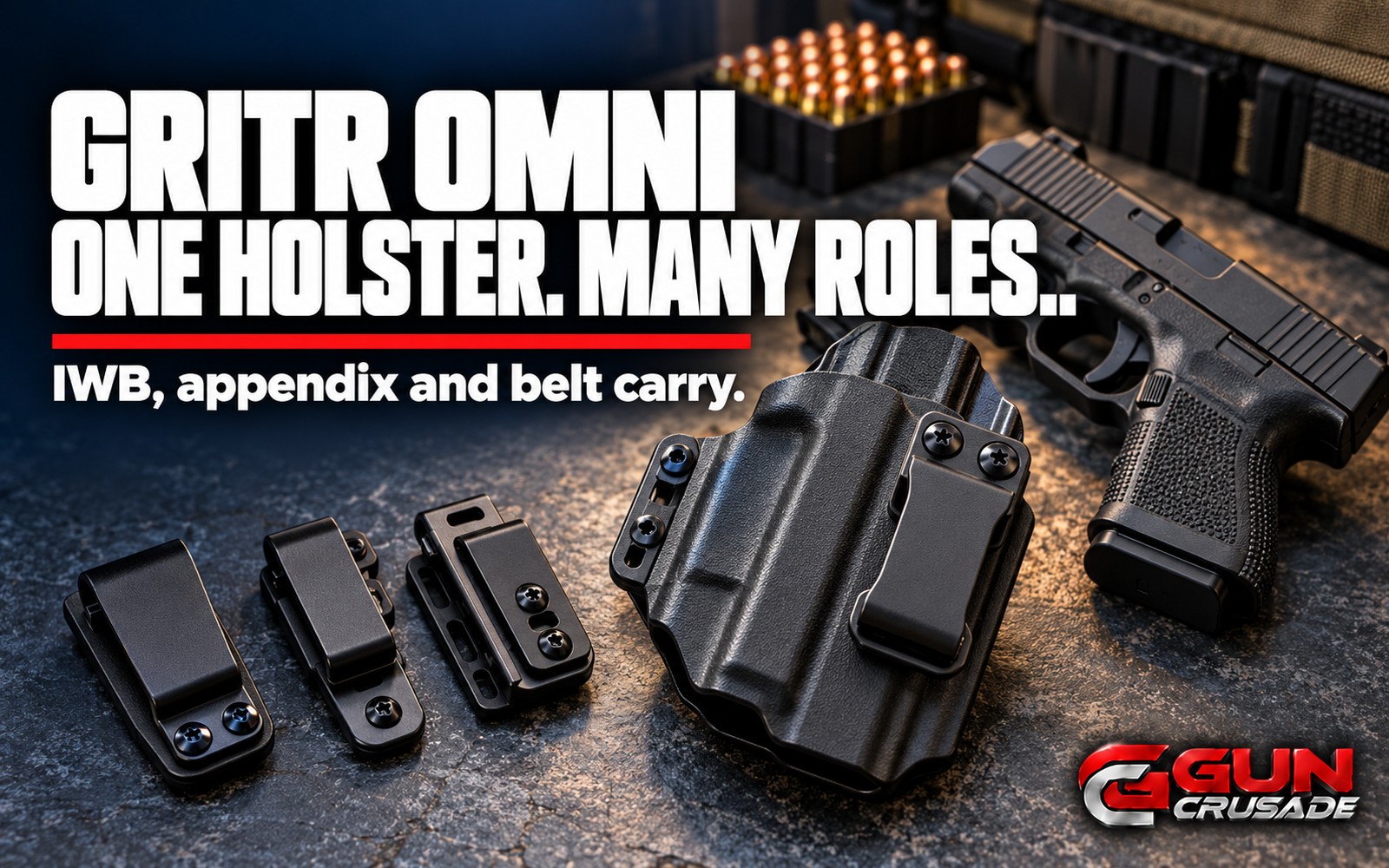
Most concealed carriers end up with a drawer full of holsters, one for every season, outfit and activity. GRITR is pitching a different approach. As first reported by The Firearm Blog on October 19, the company has expanded its OMNI line, a modular holster built to switch between carry styles instead of being replaced by a new one.
What the OMNI does
According to The Firearm Blog, the OMNI supports inside-the-waistband (IWB), appendix (AIWB) and outside-the-waistband (OWB) carry right out of the box. Both the IWB and OWB attachments allow adjustment of cant and ride height. The IWB clip is a tuckable 1.5-inch design, and the OWB attachment can be adjusted for different belts.
A few other details stand out:
- Thicker Kydex. The shell is formed from 0.093-inch Kydex, a step up from the 0.080-inch material common across the industry.
- Concealment claw. A stackable, adjustable claw helps rotate the grip toward the body to reduce printing. It can be removed for belt carry and doubles as a second retention adjustment point.
- Optic and muzzle friendly. An optic cut and open muzzle are meant to accommodate most red dots, threaded barrels and aftermarket compensators.
- Mounting options. The platform is compatible with aftermarket systems including Safariland QLS and G-Code RTI.
- Either hand. It ships set up for right-handed shooters but can be reconfigured for lefties.
The Firearm Blog lists pricing starting at $49.99, with models for Glock, SIG Sauer, Smith & Wesson, Springfield Armory, Canik, Staccato, CZ, Beretta, HK and others. GRITR’s own OMNI page names fits including the Glock 19, S&W Bodyguard 2.0, Hellcat Pro and SIG P365XL. Check the exact pistol, optic and light combination you carry before ordering.
Does a do-everything holster make sense?
GUN Crusade’s take: For a lot of carriers, especially newer ones, a convertible holster is a sensible starting point. You can try appendix carry, decide it is not for you, and move to strong-side IWB or a belt rig at the range without buying a whole new holster. It also makes it easier to keep one familiar draw platform for the same gun across different days.
The trade-off is that every adjustable part is something to set up correctly and check from time to time. Hardware that is set loose or rotated a few degrees changes where the gun rides, and that changes your draw.
What to check with any carry holster
Whatever brand you choose, a good carry holster should do a few jobs every time:
- Cover the trigger guard completely with rigid material, so nothing can reach the trigger while the gun is holstered.
- Hold the gun securely. Turn it upside down, unloaded, and give it a shake. It should stay put but still draw cleanly.
- Stay put on your belt. A sturdy gun belt matters as much as the holster. If the holster comes out with the gun, fix that before you carry.
- Allow a clean grip. You should be able to get a full firing grip before the gun leaves the holster.
After you change the configuration, unload the pistol, verify it is empty, and practice slow, careful dry draws at home before carrying or practicing at speed on the range. Re-holster slowly and look the gun into the holster, keeping clothing and cords clear of the opening.
A holster is not the most exciting purchase, but it may be the most important accessory a carrier owns. If the OMNI fits your pistol and your daily routine, its flexibility could save money and keep your carry setup consistent from Sunday dress clothes to Saturday chores.